
New Zealand is famous for its breathtaking landscapes, Māori culture, volcanic scenery, geothermal wonders, dramatic fjords and towering glaciers. But beyond its incredible scenery, New Zealand is also home to an astonishing variety of wildlife, including many species found nowhere else on Earth.
I spent three months travelling around New Zealand in a campervan, and along the way I found many of the country’s unique animals. From the rare yellow-eyed penguins and New Zealand fur seals to dolphins and sperm whales, I visited some of the best wildlife destinations across both islands.


As wildlife wasn’t the sole focus of my trip, this isn’t an exhaustive list of every species found in New Zealand. Instead, it is a collection of the animals I was fortunate enough to see, alongside some of the best places for visitors to encounter them. Therefore, I have left out New Zealand’s most famous bird, the kiwi. Although there are estimated to be 68,000 kiwis in the wild, they are notoriously difficult to spot. Sadly, I didn’t have the budget to make the trip to Stewart Island, one of the best places to see them in their natural habitat.
If you’re looking for wildlife hotspots in New Zealand, Kaikōura and the Catlins are two destinations I’d highly recommend adding to your itinerary. Kaikōura is well-known for its year-round population of sperm whales, as well as a variety of dolphin species and colony of New Zealand fur seals. Further south, the Catlins is a fantastic destination for birdwatching, along with opportunities to spot fur seals, New Zealand sea lions and penguins along its rugged coastline.


Whether you’re a dedicated wildlife enthusiast or simply hoping to see some of New Zealand’s incredible animals during your travels, this guide covers those you’re most likely to encounter, the best places to find rarer species, interesting facts about each one, and how to enjoy these encounters responsibly.
Common Birds
Starting off, here are the common birds you are likely to see across New Zealand.
Common Myna (Arcidotheres tristis)

Native to South East Asia, these cheeky birds now live all around the world, including New Zealand’s North Island.
Sadly they are quite aggressive towards native birds, often kicking them out of nesting holes
They eat a mix of insects, fruit and scraps.
Conservation Status: Least Concern
Black Swan (Cygnus atratus)
Black swans were introduced initially from Melbourne, Australia, however natural colonisation is also likely to have occurred.
Scattered across New Zealand mostly on lakes and estuaries.
National population of about 50,000.
Legal gamebird in most parts of New Zealand with up to 7,000 shot annually.
Conservation Status: Not Threatened

Pictured above in Hobbiton Movie Set Tours (read my full guide to this magical place here)
Yellowhammer (Emberiza citrinella)

Introduced from Britain between 1865 and 1879, it has spread widely.
They feed on a variety of seeds and invertebrates.
Common across throughout the mainland of New Zealand.
Found in open country, including farmland with ditches and hedgerows, pastures and stubble fields.
Conservation Status: Introduced and Naturalised
White-faced Heron (Egretta novaehollandiae)
White-faced herons are New Zealand’s most common heron despite only being introduced in the 1940s.
They consume a wide range of prey including small fish, crabs, worms, spiders, mice, lizards tadpoles and frogs.
Originally an Australian immigrant that began breeding in New Zealand in the 1940s, it now thrives across both the North and South Islands in coastal and inland habitats

Conservation Status: Not Threatened
Pūkeko / Australasian Swamp Hen (Porphyrio melanotus)

Found throughout New Zealand, near sheltered fresh or brackish water.
High population densities in areas of the North Island and west coast of the South Island.
Primarily eat stems, shoots, leaves and seeds of grasses.
Appears in various Māori traditional stories and proverbs (whakataukī) as a symbol of resilience, resourcefulness, and bold adaptation
Conservation status: Not Threatened
Kerekū / New Zealand Pigeon (Hemiphaga novaseelandiae)
This endemic bird has a widespread distribution throughout the country.
They inhabit a wide variety of forest types as well as farmland shelterbelts, urban parks and gardens.
They eat buds, leaves, flowers and fruit from a wide variety of species.
Although a major issue in the 1900s, habitat loss has had little impact on regional populations today.

Their main threat is predation by introduced species, collision with vehicles and windows, electrocution and illegal hunting.
Conservation Status: Not Threatened
Paradise shelduck (Tadorna variegata)

Paradise shelduck’s are endemic to New Zealand, and the most widely distributed waterfowl.
Their population is still increasing despite being a gamebird with at least 200,000 shot annually.
Diet includes pasture grasses and clover, aquatic plants and invertebrates.
After excessive hunting caused populations to decline, conservationists introduced a hunting pause to help them recover and expand their range.
Conservation Status: Not Threatened
Variable Oyster Catcher (Haematopus unicolor)
These endemic birds occur around most of the coastline of all main islands and their offshore islands.
Often seen in pairs probing busily for shellfish along beaches or in estuaries.
Variable oystercatchers are long-lived, with some reaching 30+ years of age.
People previously hunted variable oystercatchers for food, causing their numbers to fall to very low levels. After gaining legal protection in 1922, their population has increased rapidly.

Conservation Status: Recovering
South Island Pied Oyster Catcher (Haematopus finschi)

The endemic South Island pied oystercatcher (SIPO) is the most abundant oystercatcher in New Zealand.
They occur throughout New Zealand in most estuaries and harbours.
Several threats could affect future SIPO populations, including land use changes in breeding areas, pollution of winter feeding areas, and increased disturbance to feeding and roosting birds at coastal sites.
Conservation Status: Declining
Bar-Tailed Godwit (Limosa lapponica)
A native bird that forages in the intertidal mudflats.
Bar-tailed godwits were birds of mystery for Māori people, who believed they accompanied spirits of the departed.
They perform the longest nonstop flights of any non-seabird, with the ability to fly for up to 11 days without landing, eating or drinking.
They breed in western Alaska and migrate to New Zealand and eastern Australia.

Bar-tailed godwits are fully protected in New Zealand.
Current count data indicates an annual population decline of nearly 2%, the primary driver of which is extensive habitat loss at staging areas in the Yellow Sea region.
Godwits tend to be wary and easily spooked, and so preventing or minimising disturbance at high tide roost sites is an important conservation consideration.
Conservation Status: Declining
New Zealand Scaup (Aythya novaeseelandiae)

The endemic New Zealand scaup are gregarious diving ducks common throughout New Zealand.
They are vulnerable to predation during nesting and chick-rearing which may result in low breeding success.
Populations apparently declined during late 1800s and early 1900s due to land clearance, associated hydrological changes, predation and hunting.
They are widely but patchily distributed throughout the North and South Islands.
Conservation Status: Not Threatened
Sacred Kingfisher
The only kingfisher native to New Zealand.
Their habitats include forests, river margins, farmland, lakes estuaries and rocky coastlines.
Cats occasionally catch kingfishers, and many die or are stunned by flying into window glass.
In the past, people considered kingfishers a threat to goldfish, trout, domestic fowl and bees, so they persecuted the birds as a result.

They are common and widely distributed.
Conservation Status: Not Threatened
California Quail

California quail are small, plump introduced game birds.
They are common in open shrublands throughout most of the country.
California quail are native to western USA. People have now introduced them to most continents as game birds. The first release in New Zealand was at Papakura in 1862.
Conservation Status: Introduced and Naturalised
Eastern Rosella (Platycercus eximius)
Eastern Rosella’s are native to south-eastern Australia. People introduced them to New Zealand in the early 1900s, and they are now common over much of the North Island.
Eastern rosellas could potentially have detrimental effects for native parrots through spreading parrot-specific disease organisms not otherwise present.
Mainly seen in open, partially wooded landscapes.

Conservation Status: Introduced and Naturalised
Tūī (Prosthemadera novaeseelandiae)

An iconic bird endemic to New Zealand.
They are a boisterous, medium-sized, common and widespread bird of forest and suburbia.
Tūī are widespread and locally abundant on the North, South and Stewart Islands.
Their preferred diet is nectar and honeydew.
Tūī have probably benefitted from the introduction to New Zealand of a variety of flowering and fruiting plants.
Tūī are notoriously aggressive, and will defend a flowering or fruiting tree, or a small part of a large tree, from all-comers, whether another tui or another bird species.
Conservation Status: Not Threatened
Rarer Birds
Kea (Nestor notabilis)
The Kea is the world’s only alpine mountain parrot.
They got their name from their signature call; a long high-pitched kee-ee-aa-aa, often you hear one before you see it!
They are endemic to New Zealand and conservationists now estimate that fewer than 7,000 remain in the wild.
Hunters shot Kea for bounty as a measure to protect sheep until 1971, and the government granted them full protection in 1986.
Ongoing threats include introduced predators, such as stoats and feral cats, conflict with humans and plagues.


New Zealand’s South Island is the only place kea live. Arthur’s Pass Village is a hotspot, and I saw kea in the cafe there both times I visited. They are also often seen at Homer’s Tunnel on the way to Milford Sound in Fiordland National Park, as well as in Franz Josef on the West Coast. Out of all the wildlife in New Zealand, Keas are definitely my favourite bird.
Kea are very inquisitive birds and often interact with humans due to their curiosity and ability to problem solve. People must never feed the kea human food, as this interrupts their natural instincts. If you see a Kea you should keep your belongings secure, as these cheeky birds love to chew and pull on soft plastics and rubber.
Conservation Status: Nationally Threatened
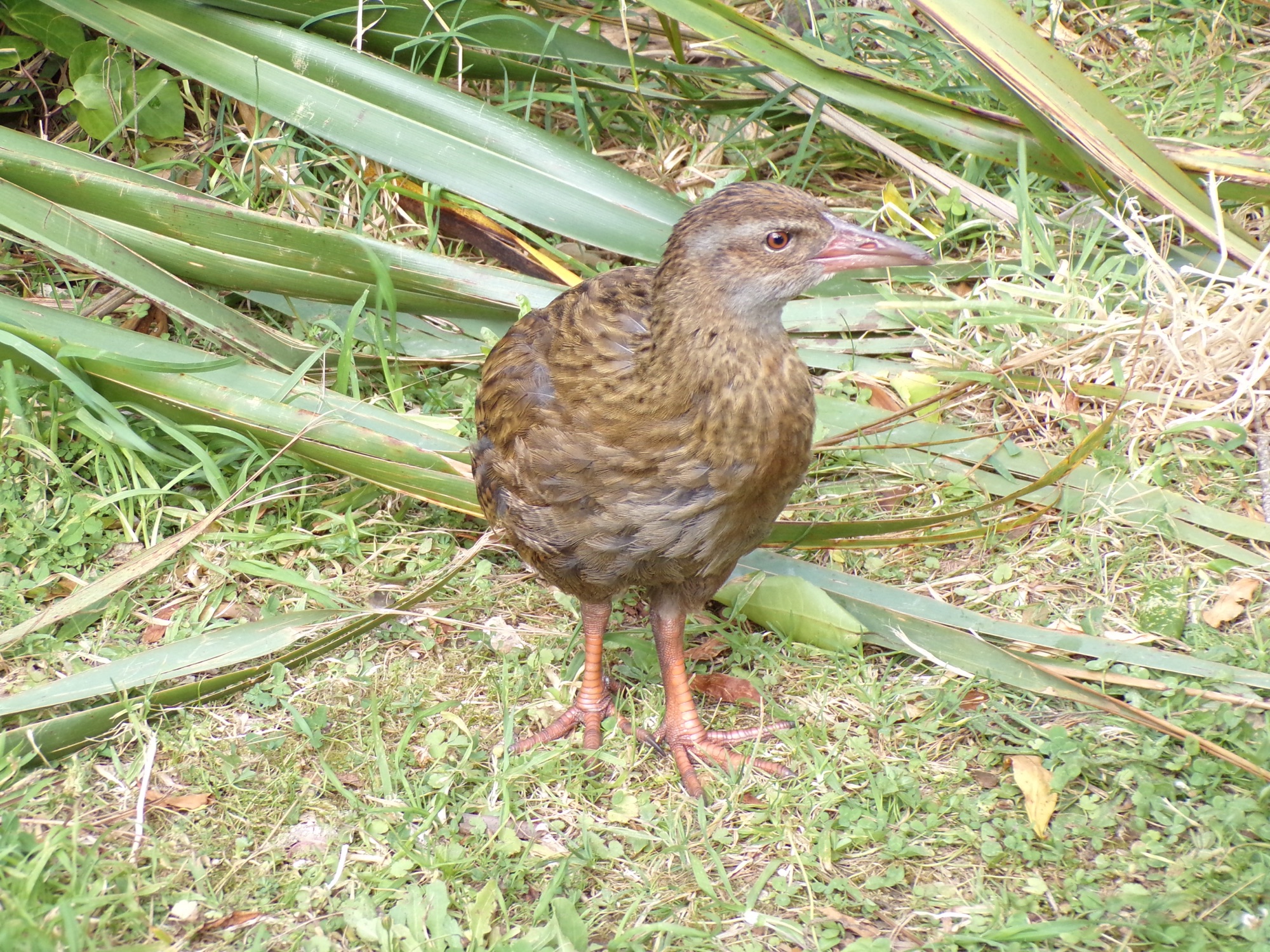
Western Weka (Gallirallus australis)

The endemic weka is one of New Zealand’s iconic large flightless birds.
Weka are charismatic birds that are often attracted to human activity.
They are fully protected on mainland New Zealand.
The main recognised threats are starvation during droughts, and predation by mustelids, especially ferrets.
Found across New Zealand, I saw weka in Malborough Sounds and by the Hokitika Gorge.
Western Weka is the most widespread species.
Conservation Status: Not Threatened
The North Island Weka and Buff Weka are both relict (a small population has survived as an isolated remnant of a formerly widespread and diverse group). The Stewart Island weka is nationally vulnerable.
Pūteketeke / Australasian Crested Grebes (Podiceps cristatus)
The Australasian crested grebe occurs in New Zealand and Australia but it is threatened in both countries. The New Zealand population probably numbers fewer than 1000 birds.
They are unusual in the way it carries the young on their back when swimming.
Crested grebes occur widely in the South Island but are extinct in the North Island.

They are famous for winning New Zealand’s 2023 “Bird of the Century” campaign, which helped improve conservation efforts.
On Lake Wanaka, local retired zoologist John Darby created floating platforms to help the birds build nests, which has led to an increased population.
Conservation Status: Nationally Vulnerable
Fiordland Crested Penguin (Eudyptes pachyrhynchus)
Endemic to New Zealand, these penguins breed in small colonies on inaccessible headlands and islets along the shores of south-western South Island and Stewart Island.
Populations have declined considerably in range and numbers since human arrival.
Immediate threats include fisheries bycatch, introduced predators, and human disturbance.


They can be seen and heard on landing beaches during July – December.
Conservation Status: Declining
I was lucky enough to see this penguin on Porpoise Beach in the Catlins (click here to read all about the amazing wildlife in this beautiful place).
Yellow-Eyed Penguin/ Hoiho (Megadyptes antipodes)
This endemic bird is thought to be one of the world’s rarest penguin species.
Experts estimate the global population to be 2600-3000 mature individuals

The largest of the penguins breeding on the New Zealand mainland, the yellow-eyed penguin has become a flagship species for nature-based tourism in the southern South Island.
On land, loss and fragmentation of habitat reduces reproductive success through predation, disease, human disturbance, heat stress and hypothermia.
Predation of chicks by introduced mammalian predators is one of the most significant impacts on yellow-eyed penguins.
I saw this yellow-eyed penguin chick from Nugget Point in the Catlins. I also waited for hours at dusk in Curio Bay, the Catlins, to try and spot them, and I had a vague sighting at 10pm but it was too dark to really see anything then. There are tons of signs warning people to stay off the beach at dusk as to not scare away the penguins, but sadly many people still ignored them. A DOC worker came just before dusk to remove people from the beach, which I was very grateful for.
Conservation Status: Nationally Endangered
Mammals
New Zealand Sea Lion (Phocarctos hookeri)
One of the rarest sea lion species in the world.
Total population estimate of less than 10,000 individuals and fewer than 5,000 breeding adults.
New Zealand sea lions breed on land and forage exclusively at sea. They are carnivores that eat a wide range of prey species.
New Zealand sea lions face a variety of threats including Commercial and recreational fisheries, human disturbance and deliberate killings, harassment by dogs, vehicle collisions, boat propeller strike, aquaculture, oil spills, disease, and shark predation.
Conservation Status: Nationally Endangered.

The above picture was taken when somebody got far too close to this large animal, proving you should always stay at least 20 metres away from them
New Zealand Fur Seal (Arctocephalus forsteri)
They can be distinguished from seal lions by their pointy noses and smaller size.
The last total population estimate was 200,000 in 2001, but it is unknown by how much this number has risen since.
Threats include entanglement, climate change, overfishing, tourism, harassment, dogs and deliberate harm.
They are also found in Southern and Eastern Australia.


Their habitats include rocky coastlines and offshore islands characterised by large, jumbled angular rocks, boulder-strewn beaches, smooth rock platforms and some vegetated areas.
The above pictures were taken of the New Zealand fur seals from the Kaikōura Peninsula seal colony. There is easy access from the car park, with seals lounging on the rocks near the shore and along the Kaikōura Peninsula Walkway. Always keep at least 20 meters away from resting seals and never block their path to the sea.
Conservation Status: Not Threatened
Dolphins
A variety of dolphin species can be found across New Zealand, and I was lucky enough to see 4 of them over 3 months.
Dusky Dolphins (Lagenorhynchus obscurus)
Dusky dolphins have virtually no beak, and their dorsal fin is not hooked and rather blunt. They are characterised by a bluish-black colour on their back and tail with white on the underside of their body. Often appearing south of East Cape, they are rare in more Northern waters. They’re most populous in Kaikōura and Admiralty Bay in the Malborough Sounds. There are thought to be between 12,000 and 20,000 individuals in New Zealand.
Conservation Status: Not Threatened
Short-Beaked Common Dolphins (Delphinus delphis)
Short-beaked common dolphins are found in waters throughout New Zealand and Australia. In New Zealand, this species tends to remain a few kilometres from the coast and is particularly common north of Kaikōura in the Hauraki Gulf and off Northland. Common dolphins may form enormous schools of several thousand individuals. I saw a pod of common dolphins while on a whale watch tour in Kaikōura.
Conservation Status: Not Threatened
Hector Dolphins (Cephalorhynchus hectori)
Hector dolphins are endemic to New Zealand and are the smallest and rarest breed of dolphin. A North Island subpopulation of Hector Dolphins has recently been recognised as a subspecies: the Māui Dolphin. The estimated total population of Hector’s dolphins in New Zealand is approximately 15,000 individuals older than one year. There are only about 54 Māui dolphins over one year old, meaning they are critically endangered.
I would highly recommend visiting Jackson Bay, which is 30 minutes south of Haast on the west coast of the South Island. Offshore of Diamond Beach there is a nursery of hector dolphins. They swim in the waves and can be easily viewed from the shore. You can swim at Diamond Beach, but it’s important to give the dolphins plenty of space and never chase, approach or deliberately startle them. Watching from the shore allows you to enjoy these incredible animals while keeping your impact on them to a minimum.
Conservation Status: Nationally Vulnerable
Bottlenose Dolphin (Tursiops truncatus)
Between 1000-5000 bottlenose dolphins can be found across New Zealand, but are most populous in the Bay of Islands, the Hauraki Gulf, Tasman Bay, Golden Bay and Fiordland. New Zealand’s bottlenose dolphins, particularly those in the far south, are among the largest of the species in the world. They are nationally vulnerable, with a variety of threats including habitat degradation, boat strikes and adverse effects of tourism.
I saw some in Milford Sound (a complete guide to this beautiful place can be found here). A few of them swam in the wake and around the boat, and made our trip all the more special.
Conservation Status: Nationally Vulnerable
Sperm Whale (Physeter macrocephalus)
Sperm whales were probably the most incredible wildlife I saw in New Zealand (and certainly the biggest!). There are between 5,000-20,000 sperm whales in New Zealand, with many residing in Kaikoura, on the South Island’s east coast. This is because an 800-metre-deep trench sits right off the coast, bringing deep-water food up to the whales. They can dive up to 2000m to hunt, and can stay underwater for up to 45 minutes.
I saw sperm whales in Kaikoura while on a whale watch tour with Whale Watch Kaikōura. I write more about this experience in my dedicated Kaikoura post.
Conservation Status: At Risk – Declining
Thank you so much for reading this post, I hope it helps you discover what wildlife wonders you have to look forward to in your upcoming New Zealand adventure.
I have lots of other New Zealand-related posts up so do have a look at those too!
Please like this post, and comment if you have any questions at all.
Subscribe by typing in your email below.

Leave a Reply